
Staking
Staked, delegated and unclaimed,
each on its own card.
A staking wallet holds more than one balance: what's liquid, what's bonded to a validator, and rewards not yet claimed. SimplyLedger keeps each as its own token card with its own on-chain balance, so staked capital, rewards and cash land in separate accounts and each one reconciles against the chain.
How it's tracked
One address. Three balances. Three token cards.
A validator's liquid balance, its bonded stake and its pending rewards are separate figures on chain. Each gets its own card, reads its own balance and books to its own account.
1,240.00ATOM
- Reads
- The address's own balance
- Books to
- Digital assets · liquid
- Reconciles
- On its own
50,000.00ATOM
- Reads
- Bonded to the validator
- Books to
- Digital assets · staked
- Reconciles
- On its own
312.20ATOM
- Pending rewards 296.40
- Validator commission 15.80
- Reads
- Rewards and unbonding
- Books to
- Staking rewards receivable
- Reconciles
- On its own
Illustrative balances and account names. Commission counts only where the address runs a validator, and only the commission it has earned, never the pool it owes its delegators.
How it posts
Staking moves value between cards, not out of the wallet.
When a token has more than one card in an account, each card is a contra of its own, so every staking event is a posting from one state to another.
- StakeAvailableDelegatedBonded to a validator
- Rewards accrueIncomeUnclaimed rewardsA posting rule can categorise these
- ClaimUnclaimed rewardsAvailableRewards become liquid
- UnbondDelegatedUnclaimed rewardsAvailableWaits out the unbonding period
Capabilities
Every state a staked token can be in.
Four holding types
Available, Delegated, Unclaimed rewards, and Other for anything you keep by hand. Badged everywhere the card appears.
Read through the protocol
Record where a card delegated and its staked balance or rewards are read back from that protocol, day by day.
Validator commission included
On Cosmos chains, the commission a validator has earned counts with its unclaimed rewards. The pool it owes its delegators is left out.
Movements between cards
Staking, claiming and unbonding post between a wallet's own cards, so value moves between states without leaving the account.
Rules for recurring rewards
A posting rule can target a holding type, so rewards that arrive on a schedule categorise themselves.
Like with like at period end
Each card reconciles against the balance held in that state on the closing date, never a combined figure that wouldn't agree.
Workflow
From validator to reconciled balance.
- Step 01
Create the cards
One per holding type on the staking wallet. Delegated and unclaimed reward cards ask where you delegated.
- Step 02
Collect balances
Daily closing balances are read from the chain or the protocol, including history from before the card existed.
- Step 03
Post the movements
Stake, rewards, claims and unbonding post between the cards, with posting rules doing the repeat work.
- Step 04
Reconcile each card
Close the period card by card, each against its own on-chain balance.
In the product
See it in SimplyLedger.
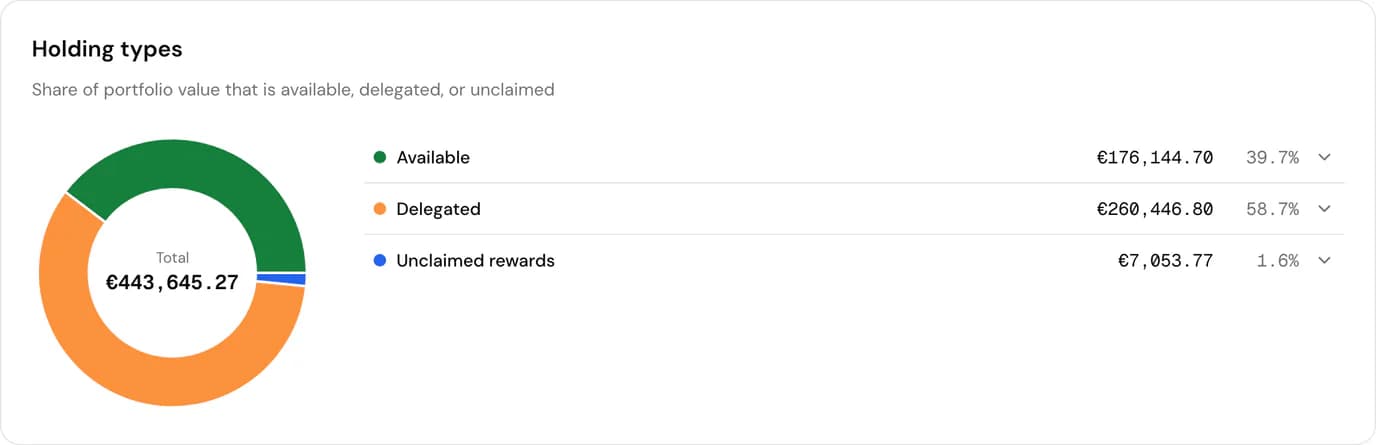
Value by holding type
The portfolio's split between available, delegated and unclaimed rewards, with each token underneath.
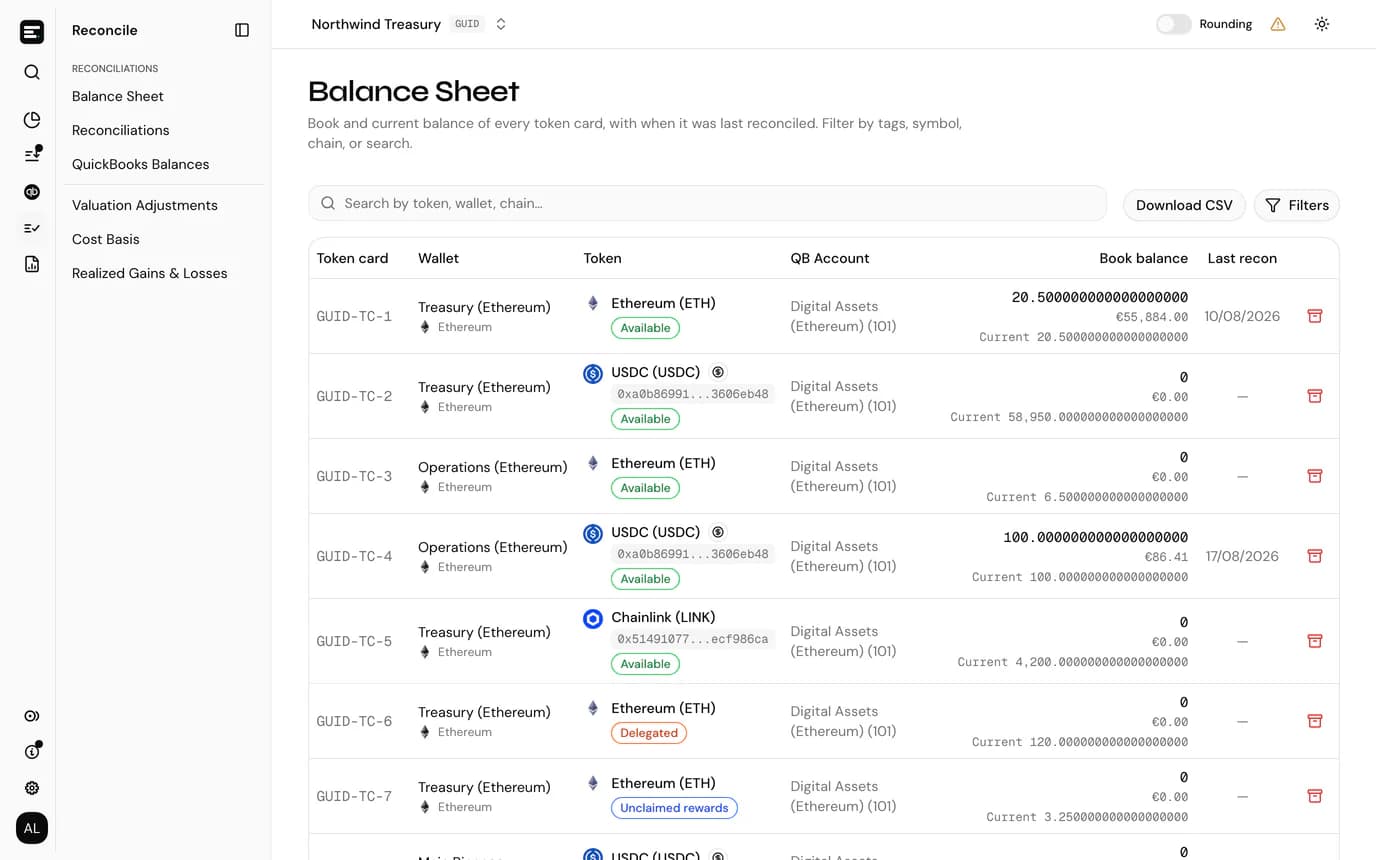
A card for every state
Delegated and unclaimed reward cards sit beside the available one on the balance sheet, each with its own book balance and last reconciliation.
FAQ
Common
questions.
Quick answers about how SimplyLedger fits your stack. Need something more specific?
Talk to usWhy can't one card hold the whole balance?
Because the chain doesn't report it that way. Bonded stake, pending rewards and the liquid balance are separate figures, and a reconciliation against a combined card would never agree.
Which chains and protocols are supported?
Protocols are mapped per token, address and chain, and the card only offers the ones that apply. Some chains report staked balances against the address itself and need no protocol. If yours is missing, support adds it centrally.
Can a card's holding type be changed later?
No. It's fixed when the card is created, because postings and reconciliations attach to the card. If a protocol you need is missing, raise it with support rather than creating the staked position as Available.
Does it work in portfolio mode?
Yes. The portfolio's Holding types tab totals value by holding type and can split each token's rows by it.
Keep exploring
More of what SimplyLedger handles.
- Cost basisCost basis & realized gainsAVCO, FIFO, LIFO, HIFO or Spec ID per token. Opening lots, the cost of every disposal, and realized gains posted by period.Explore
- IFRS valuationIAS 38 remeasurementsCost or revaluation model per token. Impairment tested against recoverable amount, OCI surplus and disposal results posted to QuickBooks.Explore
- ReconciliationPeriod-end closePer token reconciliation against the balance actually held, recorded differences, valuation adjustments and a QuickBooks tie-out.Explore
- MatchingSwaps & bridgesBoth legs of a swap or bridge posted to a hold account and matched, with the residual posted to a difference account.Explore
- DeFi liquidityLP transactionsLiquidity pool deposits and withdrawals grouped by position, with trading fees split from principal using the pool's growth index.Explore
- Payables & receivablesBills & invoicesPick the open QuickBooks bill or invoice a crypto payment settles, and the payment is written against it as you post.Explore
- MonitoringBalance alertsAn email, Slack or Telegram message when a token card's balance goes below or above a threshold. In portfolio and accounting.Explore
Your crypto. Your books. In sync.
Book a call and we’ll walk you through the workflow for your stack.