
IFRS valuation
IAS 38 remeasurements,
posted for you.
Under IFRS, crypto held for investment is an intangible asset, not a mark-to-market position. SimplyLedger measures every token under the cost or revaluation model from its cost basis lots, its reconciled book value and the day's price, then posts the impairment, revaluation and disposal result to QuickBooks Online.
How it measures
Two models. One carrying amount.
Every token is measured lot by lot from its cost basis. Where the carrying amount lands, and which account the move goes to, depends on the model you picked for that token.
Impairment of 21
P&LEarlier impairment reversed, never above cost
P&LDecrease of 20 below cost
P&LIncrease of 30 above cost
OCI surplusIllustrative holding with a cost of 100 and costs of disposal of 1. The vertical line marks cost. Under the revaluation model an increase first reverses earlier decreases in P&L, and a decrease first uses up the surplus.
What it posts
From reconciled balance to journal entries.
A remeasurement takes the token's cost basis, the reconciled book value of every token card holding it and the day's price, and posts what brings the cards to the IAS 38 carrying amount.
Cost basis lots
FIFO or AVCO, per token
Reconciled book value
Every token card, on the date
The day's price
Fair value, less costs of disposal
IAS 38 remeasurement
One token, one reporting date
- Each lot measured on its own
- Disposals release their share of earlier adjustments
- Carrying amount by model
- Shared across token cards pro rata
Impairment
Losses and reversals
Disposal result
Proceeds less carrying amount
Revaluation surplus
Increases above cost
Retained earnings
Surplus released on disposal
Capabilities
Everything IAS 38 asks of a crypto holding.
Cost or revaluation, per token
Pick the model token by token. The cost model carries it at the lower of cost and recoverable amount; the revaluation model carries it at fair value, with gains above cost in OCI.
Impairment tested your way
Test the whole holding, or every cost basis lot on its own. Reversals of earlier impairment never take a lot above its cost.
Costs of disposal (IAS 36)
A percentage of fair value plus a fixed amount per disposal, for the entity or one token. Changes apply prospectively and never restate a posted test.
Disposal results, not just gains
Proceeds less carrying amount, net of selling fees paid in another token or fiat. Released surplus moves to retained earnings, or stays put, your choice.
Year ends enforced
Every financial year end is a reporting date. A token held over one can't be remeasured past it until it has been measured there.
Built on reconciled books
Remeasurements run on finalised reconciliations and post pro rata across every token card holding the token. Revert the latest one at any time; the audit trail keeps every change.
Workflow
From reconciled balance to posted remeasurement.
- Step 01
Set the policy
Choose IAS 38 as the valuation method, the impairment test, the financial year end, and the impairment, disposal, revaluation surplus and retained earnings accounts.
- Step 02
Reconcile to the date
Close the token cards' reconciliations on the reporting date. Cost basis lots and the day's price come in on their own.
- Step 03
Review the breakdown
Position, disposals since the last remeasurement, what goes to P&L and OCI, and what every token card carries afterwards.
- Step 04
Post, or revert
One click posts every line to QuickBooks. Reverting the latest remeasurement reopens its reconciliations so you can post it again.
In the product
See it in SimplyLedger.
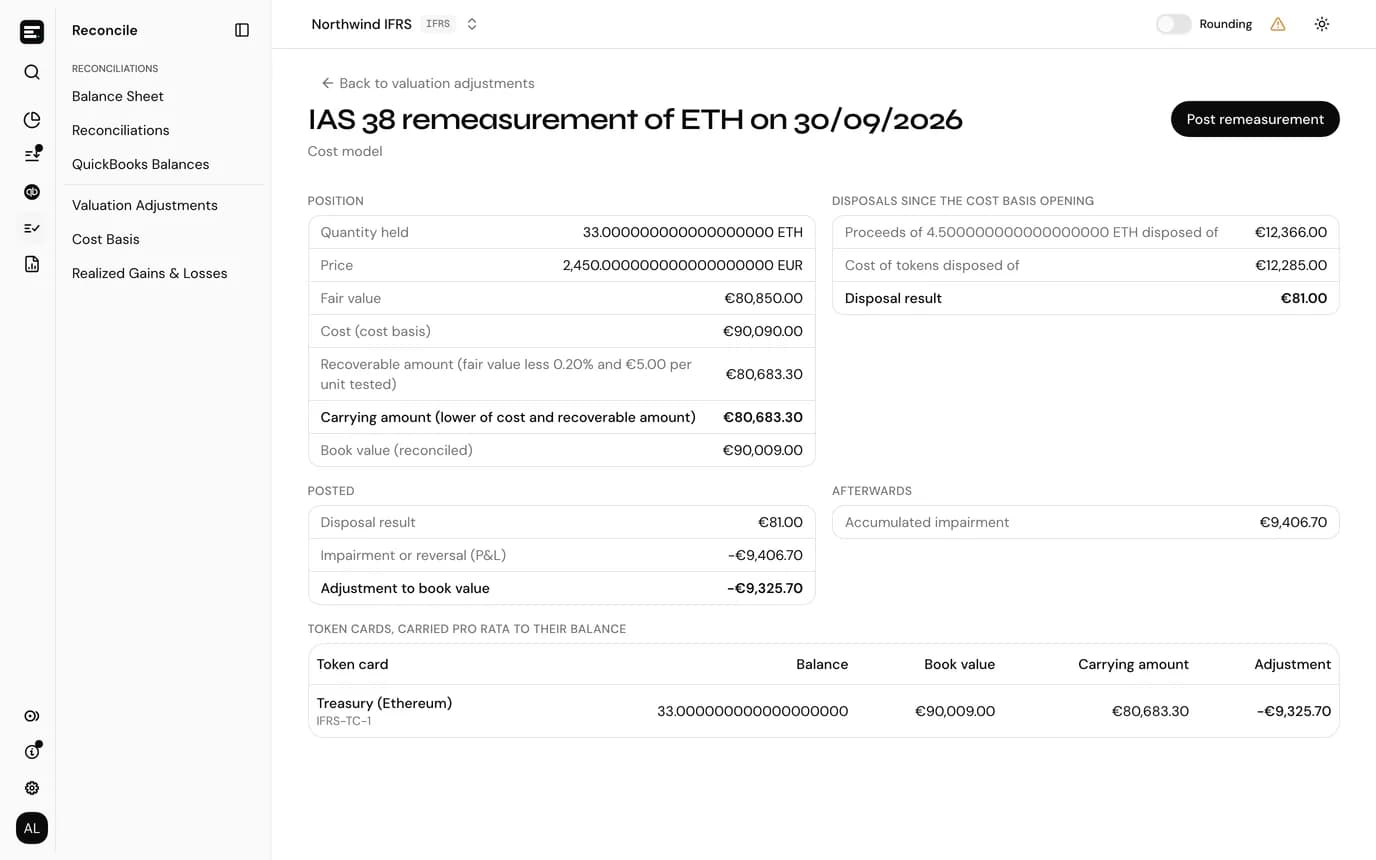
A breakdown you can hand to the auditor
Position, disposals since the last remeasurement, what is posted and what is carried afterwards, per token and reporting date.
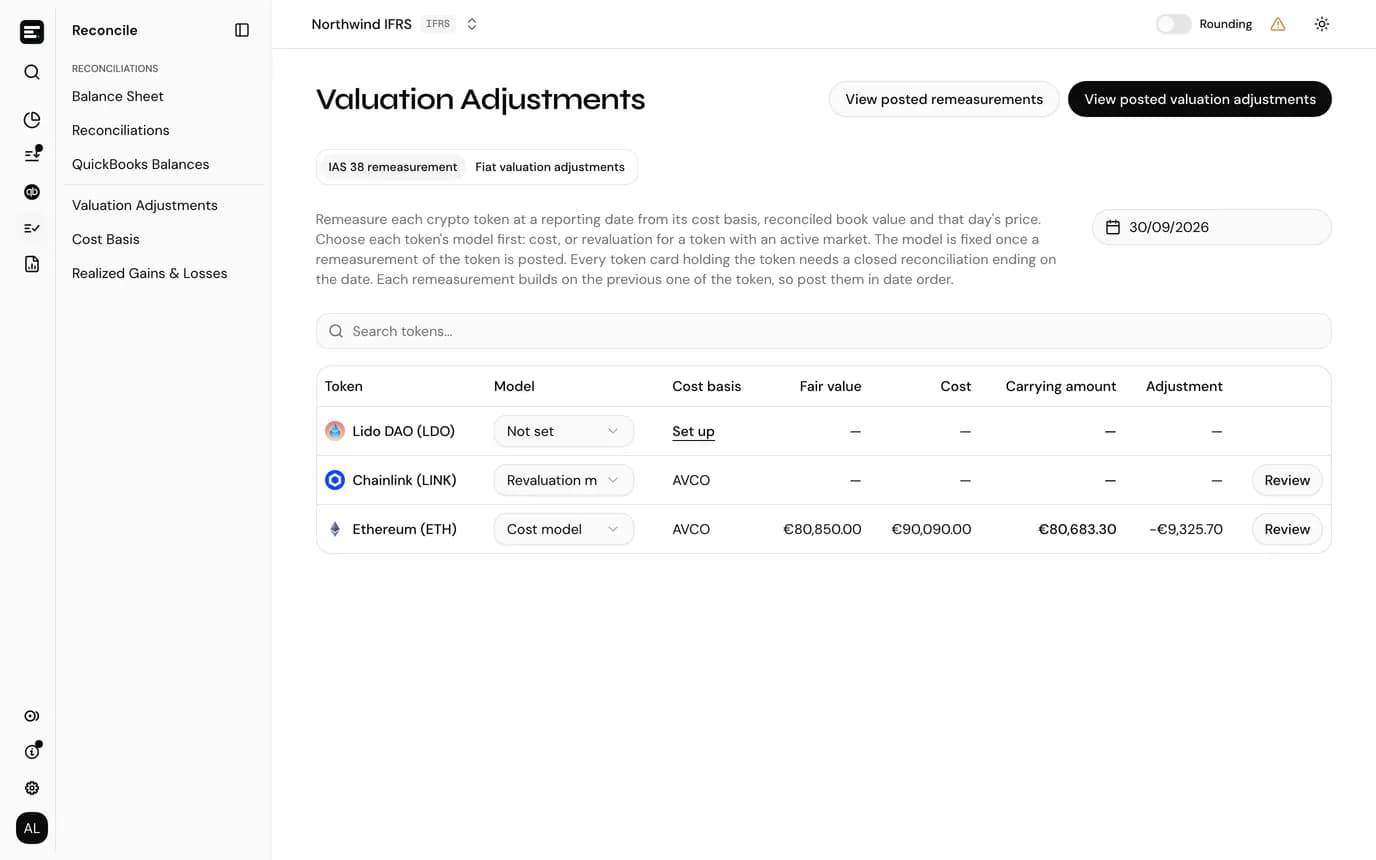
Every token on one reporting date
Model, cost basis method, fair value, cost, carrying amount and the adjustment to post, with anything blocking a token called out.
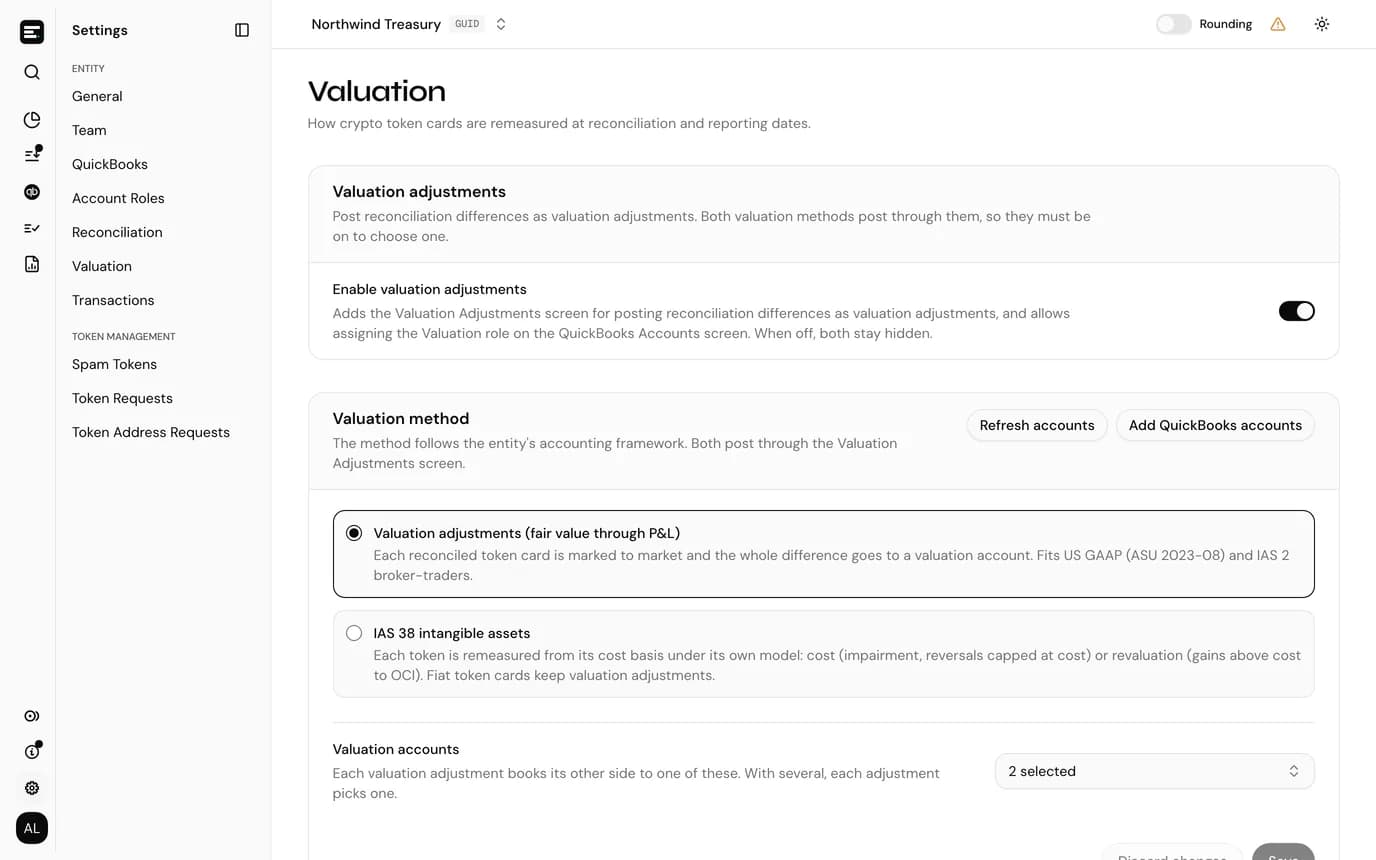
One valuation policy per entity
Valuation method, impairment test, surplus transfer, financial year end and the QuickBooks accounts each part posts to.
FAQ
Common
questions.
Quick answers about how SimplyLedger fits your stack. Need something more specific?
Talk to usWhy not just mark crypto to market?
Under IFRS, most crypto held for investment is an intangible asset (IAS 38) rather than a financial instrument, so fair value through profit or loss isn't available. Entities that don't report this way keep using fair value valuation adjustments instead.
Can an IAS 38 entity use LIFO?
No. IFRS does not permit LIFO, so IAS 38 measures from a FIFO or AVCO cost basis. Opening balances on LIFO need recreating with another method before switching.
What happens to fiat and stablecoins?
Fiat token cards aren't intangible assets, so they keep using valuation adjustments on the same screen. Stablecoins and spam tokens aren't listed for remeasurement.
How does this fit with realized gains and losses?
The remeasurement already posts the disposal result (proceeds less carrying amount), so realized gains and losses stay available to view but aren't posted a second time.
Keep exploring
More of what SimplyLedger handles.
- Cost basisCost basis & realized gainsAVCO, FIFO, LIFO, HIFO or Spec ID per token. Opening lots, the cost of every disposal, and realized gains posted by period.Explore
- ReconciliationPeriod-end closePer token reconciliation against the balance actually held, recorded differences, valuation adjustments and a QuickBooks tie-out.Explore
- MatchingSwaps & bridgesBoth legs of a swap or bridge posted to a hold account and matched, with the residual posted to a difference account.Explore
- DeFi liquidityLP transactionsLiquidity pool deposits and withdrawals grouped by position, with trading fees split from principal using the pool's growth index.Explore
- StakingStaking balancesAvailable, delegated and unclaimed reward balances tracked as separate token cards, each read from the chain and reconciled on its own.Explore
- Payables & receivablesBills & invoicesPick the open QuickBooks bill or invoice a crypto payment settles, and the payment is written against it as you post.Explore
- MonitoringBalance alertsAn email, Slack or Telegram message when a token card's balance goes below or above a threshold. In portfolio and accounting.Explore
Your crypto. Your books. In sync.
Book a call and we’ll walk you through the workflow for your stack.