Your crypto portfolio tracker is not your general ledger
A portfolio tool tells you what your wallets are worth today. A ledger tells you what you made, what you owe tax on and how it reconciles. Here's where the two split, and why mixing them up causes trouble at year-end close.
2 min read
Most finance teams in crypto start with a portfolio tracker. It's the obvious first tool: connect your wallets, see your balances, watch the total move with the market.
Then month-end arrives, and the tracker can't answer the questions the controller is actually asking.
Two different questions
A portfolio tracker answers one question: what is everything worth right now? It reads balances, multiplies them by a price, and adds them up.
A general ledger answers a different set of questions. What did we pay for these tokens? What did we make when we sold them? Which account does each movement belong to? Does the closing balance agree with the opening balance plus everything that happened in between?
The first is a snapshot. The second is a history that has to balance.
Where the snapshot runs out
A few places where a balance-and-price view stops being enough:
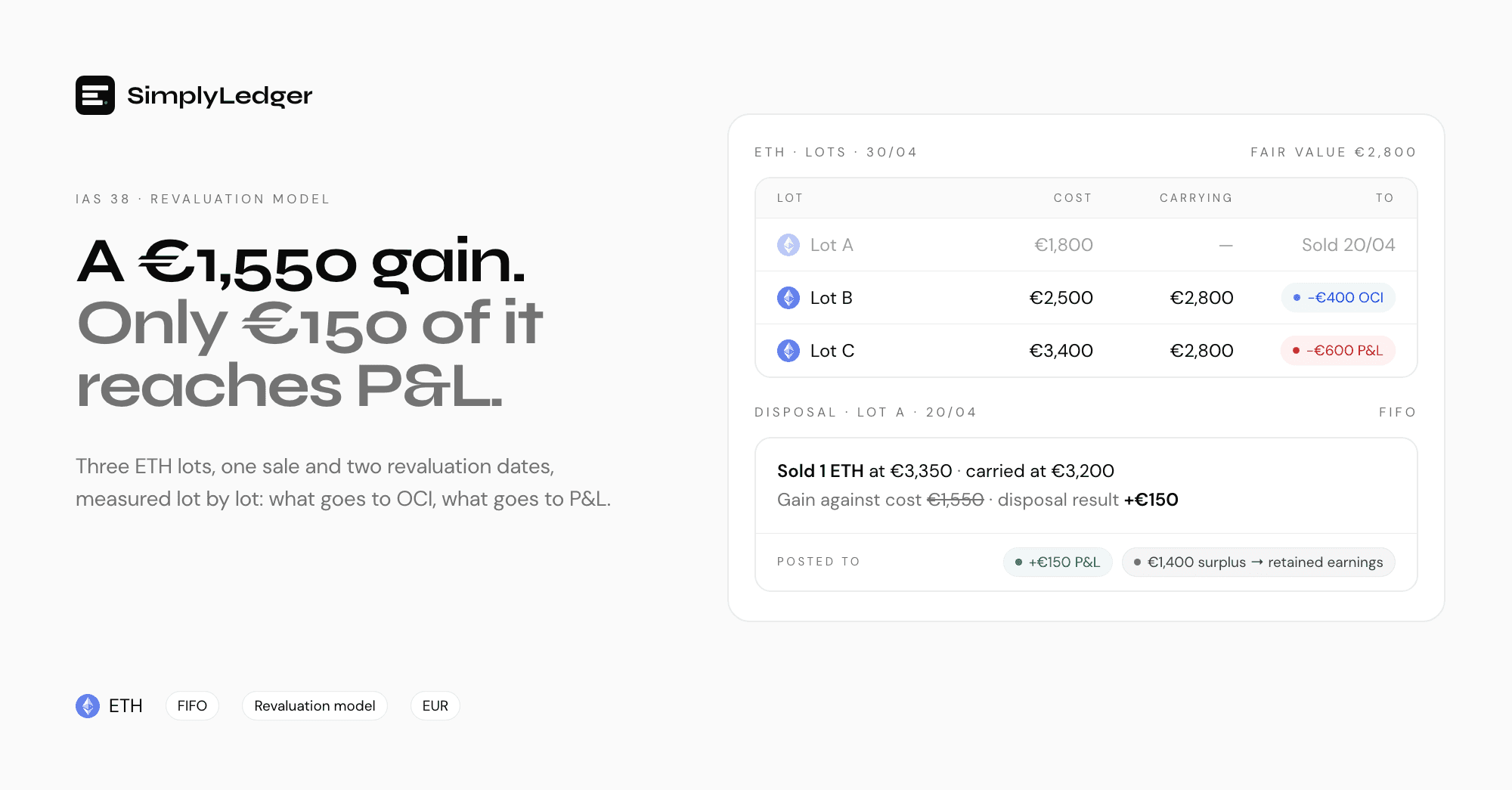
- Cost basis. Selling 12 ETH tells you nothing about the gain until you know which lots you sold and what each cost. That depends on your method, FIFO, LIFO or AVCO, applied consistently across every wallet.
- Realised vs unrealised. A tracker shows one number moving up and down. Your accounts need the realised gain on each disposal in profit or loss, kept separate from the unrealised movement on what you still hold.
- Classification. A transfer between your own wallets is not income. A staking reward is. A swap is a disposal of one asset and an acquisition of another. A tracker sees tokens moving; a ledger has to say what each movement means.
- Reconciliation. Your auditor will ask you to prove the closing balance: opening balance, plus every inflow, minus every outflow, tied to on-chain transactions. A current balance on its own proves nothing.
What a ledger entry looks like
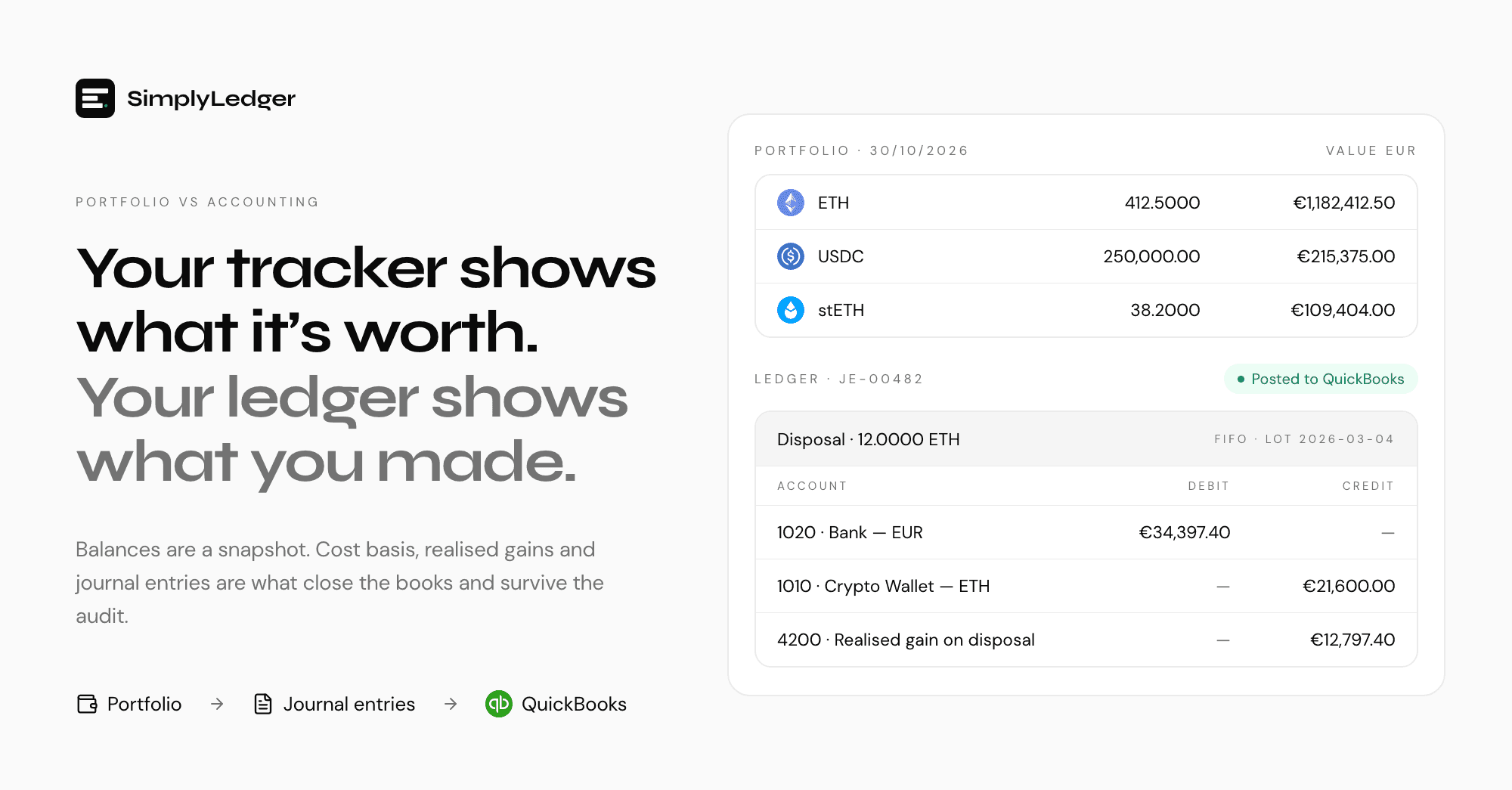
Take that sale of 12 ETH for €34,397.40. The portfolio view shows the ETH balance going down and the EUR balance going up. The ledger needs a journal entry:
- Debit 1020 · Bank — EUR: €34,397.40
- Credit 1010 · Crypto Wallet — ETH: €21,600.00, the cost of the lots sold under FIFO
- Credit 4200 · Realised gain on disposal: €12,797.40
None of those numbers except the proceeds are visible in a portfolio tracker. The cost figure comes from lot history going back to the original purchase, and the gain is the difference between the two.
Why the mix-up hurts at year-end
When the tracker is the only system, the gap gets filled with spreadsheets. Someone exports balances, rebuilds lots by hand, and types summary journals into the accounting system. It works until the auditor asks how a specific number was derived, and the answer lives in a file only one person understands.
How SimplyLedger handles both
SimplyLedger keeps both views on the same data. Portfolio shows your positions across every wallet and entity, with end-of-day pricing. Accounting takes the same transactions, applies your cost basis method and categorisation rules, and posts balanced journal entries to QuickBooks.
Every entry traces back to the on-chain transactions behind it, so the number on the balance sheet and the balance in the wallet always reconcile.
If your close still runs through a spreadsheet between your tracker and your books, send us a message. We're happy to walk you through how it works.
More on the difference: Portfolio vs accounting in SimplyLedger.