Treasury balance alerts: catching problems before month-end
A hot wallet drained below its operating float, or a multisig holding more than policy allows. Set a threshold on any token card and get an email, Slack or Telegram message when the balance crosses it, in both portfolio and accounting.
2 min read
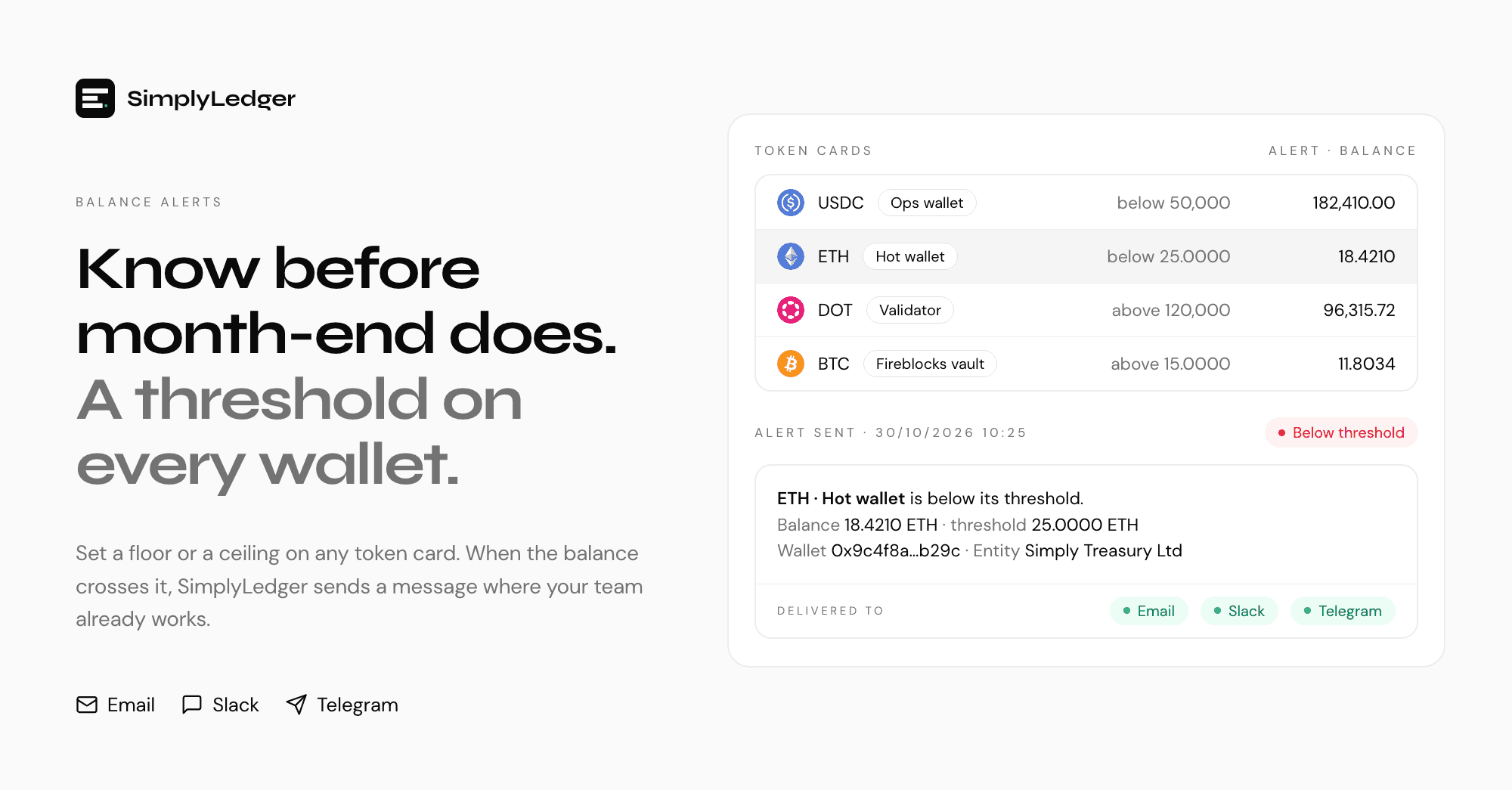
Most treasury problems are found at month-end. Someone reconciles the wallets, notices a balance that's lower or higher than it should be, and works backwards to when it happened.
By then the problem is weeks old. Balance alerts move that moment to when the balance actually changes.
How it works
Every token in SimplyLedger has a token card: one asset, in one wallet, with its balance. On any token card you can set a threshold, either below a value or above it.
When the balance crosses the threshold, SimplyLedger sends a message by email, Slack or Telegram. It names the token, the wallet and the entity, and shows the balance next to the threshold it crossed.
Alerts work the same in Portfolio and in Accounting, so treasury and finance can each watch the wallets they care about.
Four ways teams use them
Operating float. A hot wallet that pays gas, vendors or payroll needs a minimum balance. Set a below-threshold alert at the float you want to keep, and top it up before payments start failing.
Exposure caps. Treasury policy often limits how much any single wallet, exchange account or custodian can hold. An above-threshold alert tells you the moment a wallet goes over its cap.
Unexpected inflows. An above-threshold alert on a wallet that should be quiet, a cold wallet or a dormant entity, flags movements nobody planned for, whether that's a mis-sent payment or something that needs investigating.
Stablecoin runway. Put a floor on the USDC or USDT you hold for operations, and know when to convert or move funds before it becomes urgent.
Collected balances only
Alerts fire on balances SimplyLedger collects itself, from its indexer or a connected custodian. Balances entered by hand never trigger an alert.
That's deliberate. A manual balance only changes when someone edits it, so an alert on it would tell you about your own edit. Alerts are for movements you didn't see happen.
Set it up once
Thresholds live on the token card, so there's nothing to maintain elsewhere. Choose the direction, set the value, pick where the message goes, and the alert keeps watching from then on.
If you want to see how alerts fit your treasury policy, send us a message. We're happy to walk you through it.
More on the feature: Balance alerts in SimplyLedger.