The IAS 38 revaluation model for crypto: a worked example
Three ETH lots, one sale and two revaluation dates, worked through lot by lot: what goes to OCI, what goes to P&L, and why only €150 of a €1,550 gain reaches profit or loss.
3 min read
Under IFRS, crypto held for investment is usually an intangible asset under IAS 38. Under the revaluation model it is carried at fair value: increases above cost go to other comprehensive income (the revaluation surplus), decreases below cost go to profit or loss.
That is easy to state. It gets harder with several lots, a sale between reporting dates and a price that falls. Here is one quarter of ETH, worked through the way SimplyLedger measures it: FIFO, with every lot measured on its own.
The transactions
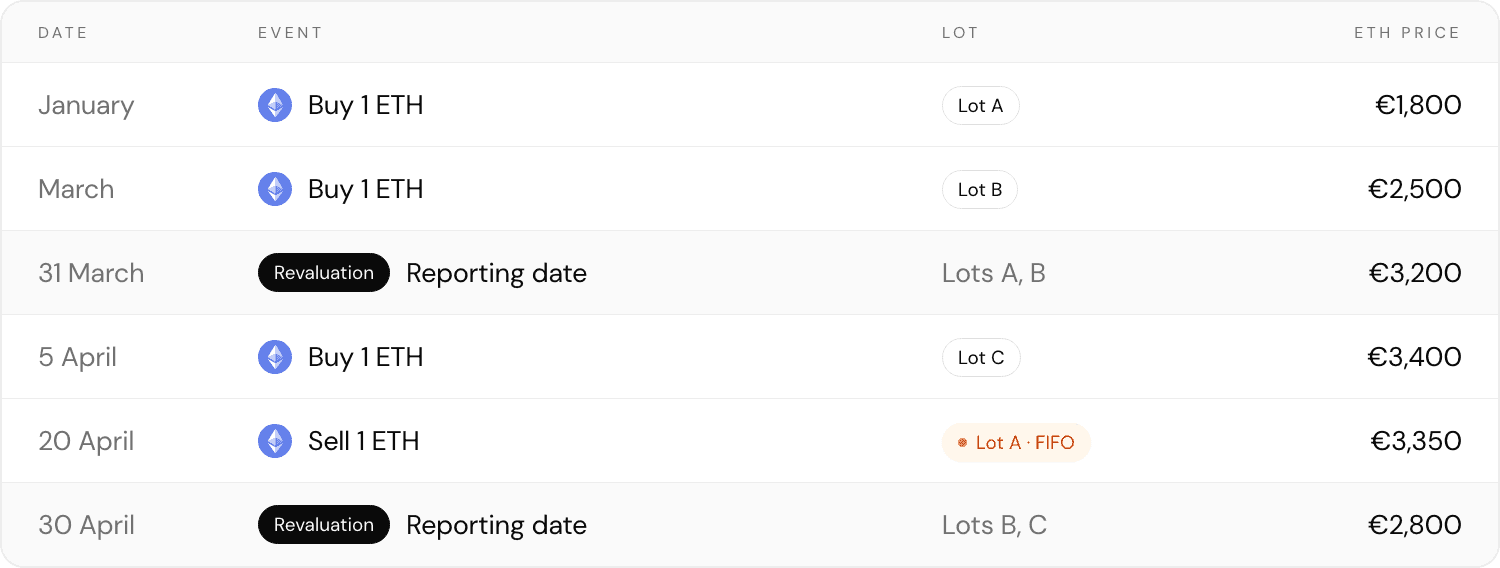
Three lots bought, one sold, two reporting dates. The entity reports in EUR, uses FIFO, has chosen the revaluation model for ETH and moves surplus to retained earnings on disposal.
31 March: the first revaluation
Two lots are held and ETH is at €3,200.
- Lot A: cost €1,800, fair value €3,200. €1,400 above cost.
- Lot B: cost €2,500, fair value €3,200. €700 above cost.
Both lots are above cost, so the whole €2,100 increase goes to OCI. Nothing touches P&L.
- Dr ETH (token cards): €2,100
- Cr Revaluation surplus (OCI): €2,100
ETH is carried at €6,400, with a €2,100 revaluation surplus.
5 April: Lot C
Lot C comes in at its cost, €3,400, with no surplus of its own.
20 April: selling 1 ETH at €3,350
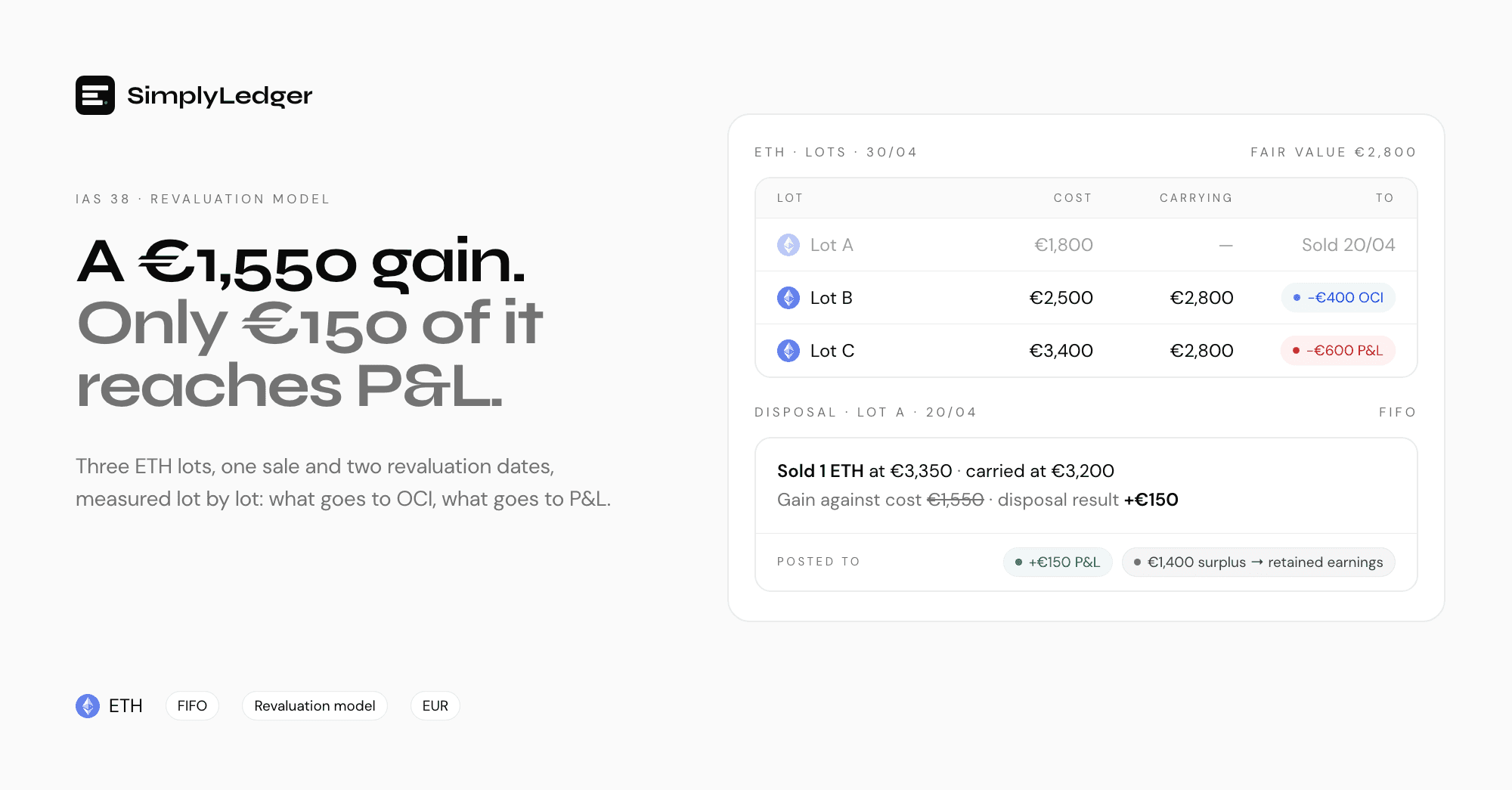
FIFO matches the sale to Lot A. Under IAS 38 the gain on disposal is the proceeds less the carrying amount, not less cost:
- Proceeds: €3,350
- Less Lot A's cost: €1,800
- Less Lot A's revaluation: €1,400
- Disposal result: +€150 to P&L
Lot A's €1,400 surplus never passes through P&L. It moves from the revaluation surplus straight to retained earnings (IAS 38.87).
- Dr Revaluation surplus: €1,400
- Cr Retained earnings: €1,400
A cost basis report would show a realised gain of €1,550 (€3,350 less €1,800). Under IAS 38 only €150 of it reaches P&L in April, because the other €1,400 was already recognised in OCI on 31 March.
30 April: ETH falls to €2,800
Lots B and C are held.
- Lot B: cost €2,500, carried at €3,200, now worth €2,800. Still above cost, so its surplus shrinks from €700 to €300: −€400 in OCI.
- Lot C: cost €3,400, now worth €2,800. €600 below cost, with no surplus to absorb it: −€600 in P&L.
The token cards hold €6,450 of book value going in (€6,400 carried, plus €3,400 bought, less €3,350 sold) and need to carry €5,600. The €850 difference splits three ways:
- Dr Impairment (P&L): €600
- Dr Revaluation surplus (OCI): €400
- Cr Disposal result (P&L): €150
- Cr ETH (token cards): €850
ETH is now carried at €5,600, the fair value of 2 ETH. The revaluation surplus is €300, all of it Lot B's, and €600 of Lot C's value below cost sits in P&L.
Why measure every lot on its own
Taken as one holding, Lots B and C cost €5,900 and are worth €5,600: €300 below cost. Lot by lot, B is still €300 above its cost and C is €600 below.
Measuring each lot keeps the surplus and the loss with the lot they belong to. When Lot B is sold, its €300 surplus is what moves to retained earnings, and if ETH recovers, Lot C's increase first reverses the €600 it lost in P&L.
The quarter in total
- OCI: +€2,100 on 31 March, −€400 on 30 April. €300 surplus left.
- P&L: +€150 disposal result, −€600 below cost. −€450 in total.
- Retained earnings: +€1,400 of surplus released by the sale.
OCI and P&L together recognise €1,250, which is exactly what happened: €7,700 paid for three ETH, €3,350 received for one, and two worth €5,600 at the end.
And under the cost model?
The same transactions under the cost model, with costs of disposal set to zero to keep it simple:
- 31 March: nothing is posted. The cost model never carries a lot above its cost.
- 20 April: the disposal result is €3,350 less Lot A's €1,800 cost: +€1,550 to P&L.
- 30 April: tested lot by lot, Lot C is impaired by €600 and Lot B stays at €2,500. Tested as a whole holding, €5,600 against a cost of €5,900 gives a €300 impairment.
Which test applies is a setting in SimplyLedger: Cost model impairment test, either each lot or the whole holding.
How SimplyLedger does it
Pick the model token by token, reconcile the token cards to the reporting date, and SimplyLedger works out every lot from the cost basis, the reconciled book value and the day's price. The breakdown shows the position, the disposals since the last remeasurement and the split between P&L and OCI, and one click posts it to QuickBooks Online.
Read more about IAS 38 remeasurements in SimplyLedger, or book a walkthrough and we'll run your own numbers through it.